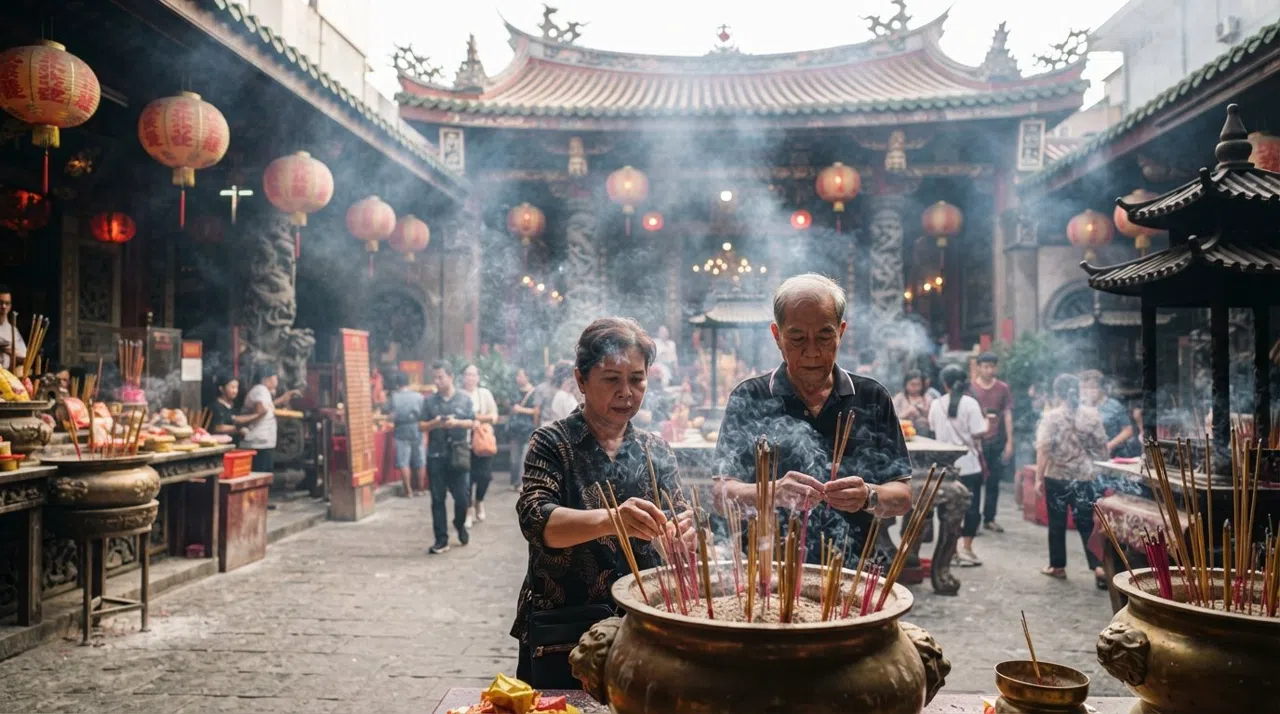
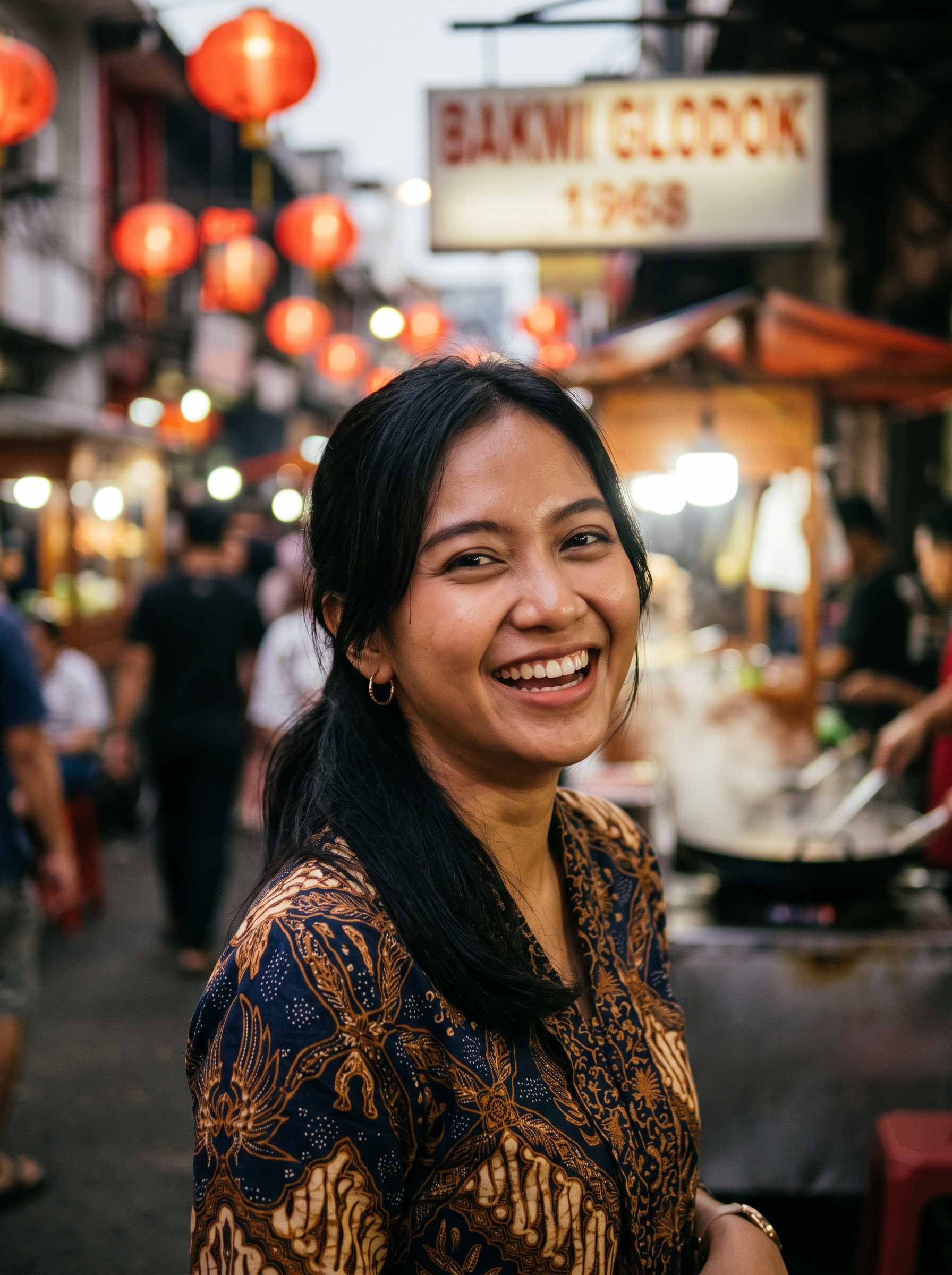
The air over Glodok is soy sauce, joss-stick smoke and the two-stroke rasp of ojek motorbikes threading a gap that shouldn’t exist. By the time you’ve stepped off Jalan Pancoran, the neighbourhood has already decided what kind of morning you’re having: one where you stand in a lane with an iced coffee in a plastic bag, or one where you get elbowed by a fishmonger and end up buying longan you didn’t know you wanted.
What Glodok is known for
Glodok is Jakarta’s oldest and largest Chinatown, and it carries that fact the way a good old market carries weight: not with ceremony, but with repetition. The Dutch pushed the city’s Chinese community here in the 1740s, after the Batavia massacre, and the neighbourhood has been the centre of Chinese-Indonesian life ever since. That history is not polished away. It sits in the incense smoke, in the family names above shopfronts, in the way a place can survive fire, suppression and riot and still manage to pour tea for strangers on the pavement.
The easiest way to understand Glodok is to start with its three layers. First, the temples. Second, the market. Third, the food, which is really the glue holding the first two together. The spiritual anchor is Vihara Dharma Bhakti, also called Jin De Yuan, Jakarta’s oldest Chinese temple, first raised in 1650 on Jalan Kemenangan III. Burned in the 1740 massacre and rebuilt in 1755, it is still a working klenteng, thick with dragon carvings, calligraphy and the kind of incense that clings to your shirt long after you leave.
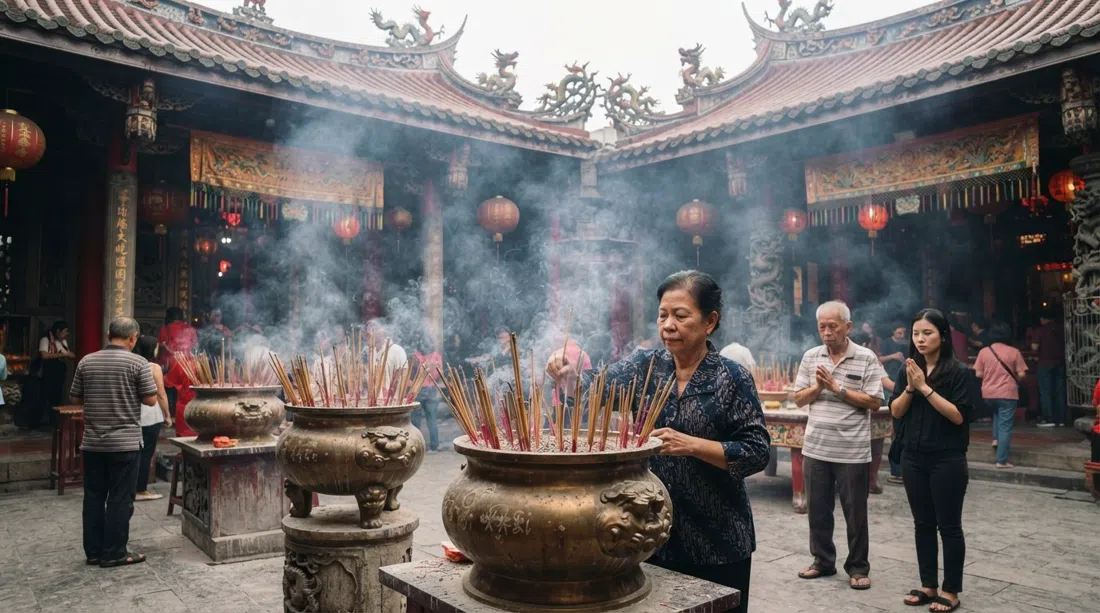
A few steps away, Vihara Toa Se Bio dates to around 1715 and is folded right into Petak Sembilan, which is exactly where a temple in Glodok should be: not separated from daily life, but part of the same bustle. This is not a neighbourhood that pauses for heritage. It keeps selling fish, fruit and roast meats while the bells ring.
Then there is the market itself. Petak Sembilan means “nine plots,” though what it feels like now is a maze of alleys where live fish, tropical fruit, household shrines and dried-goods stalls all crowd into the same narrow shade. It spills off Jalan Kemenangan and Jalan Pancoran, and on a busy day you move through it the way you move through a crowd at a wedding: sideways, apologetic, and mildly amazed that everyone else seems to know exactly where they’re going.
If you come in the days around Imlek, or especially Cap Go Meh fifteen days later, the whole place changes costume. Red lanterns appear everywhere. Mandarins stack up like small suns. Barongsai lion dances cut through the lanes and the market turns theatrical without ever losing its working pulse. That’s the trick with Glodok: it never stops being itself long enough to perform for you.
Where to eat & drink
Start with the coffee, because Glodok understands that not everyone is ready for pork at 8am, but almost everyone can manage caffeine. Kopi Es Tak Kie in Gang Gloria has been pouring the same iced kopi since 1927 and is now run by the family’s third generation. Order the es kopi susu, around Rp 22,000, and drink it standing in an alley that looks as if it has kept its own appointment book since the colonial era. It opens early and shuts by early afternoon, so if you arrive after lunch, that’s on you.
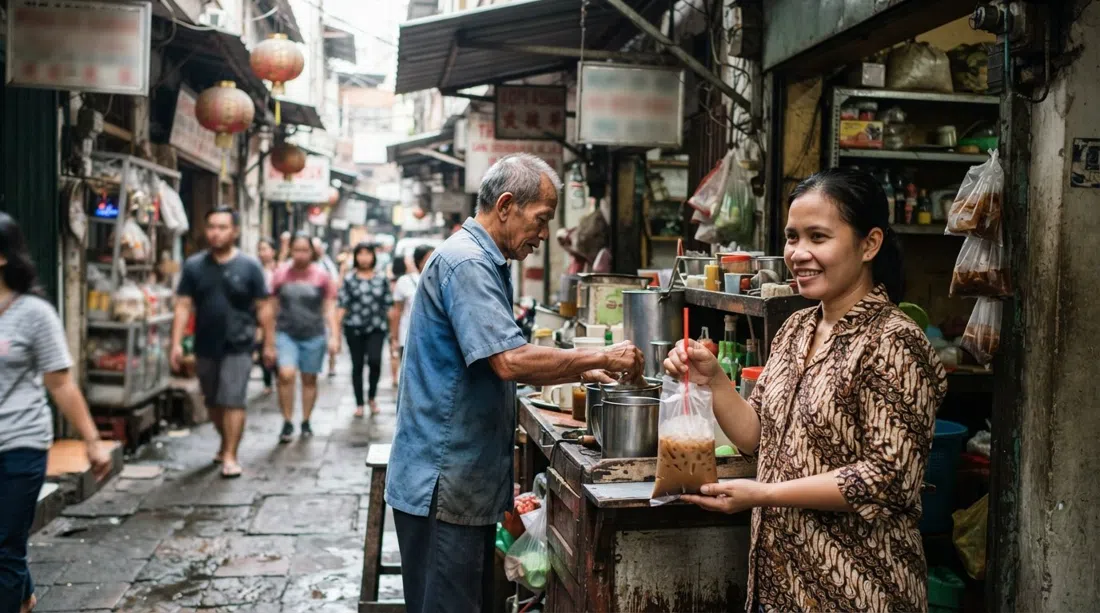
Gang Gloria is where the serious eating happens, and it does not waste time with trendiness. The lane holds roughly three dozen stalls, many of them decades old, and the best strategy is simple: follow the queue, then ask what the regulars are having. Gado-Gado Direksi has been here since 1967, named for the bank directors who used to eat there, and its peanut sauce is made with beans trucked in from Tuban in East Java. A plate runs about Rp 40,000, which in Glodok feels like a fair exchange for something that tastes like it has been refined by committee and stubbornness.
Kari Lam, open since 1973, is the sort of place where the owner still cooks the beef-and-potato curry himself. The curry is thick, steady and old-school in the best sense: not trying to surprise you, just trying to feed you properly. A few doors away, Bakmi Amoy has been slinging chicken noodles and crunchy fried meatballs from a plain corner since the early 1980s. It is exactly the kind of place you miss if you’re looking up too much and exactly the kind of place you remember on the ride home.
For a deeper Hakka detour, Wong Fu Kie over in Pasar Pagi Lama has been doing mun kiaw mien noodles and Hainan chicken since 1925, with no concessions to local tastes. That phrase sounds stern until you taste the broth, which is really a love letter to continuity. This is the kind of restaurant where the menu does not need to explain itself; the decades have already done the work.
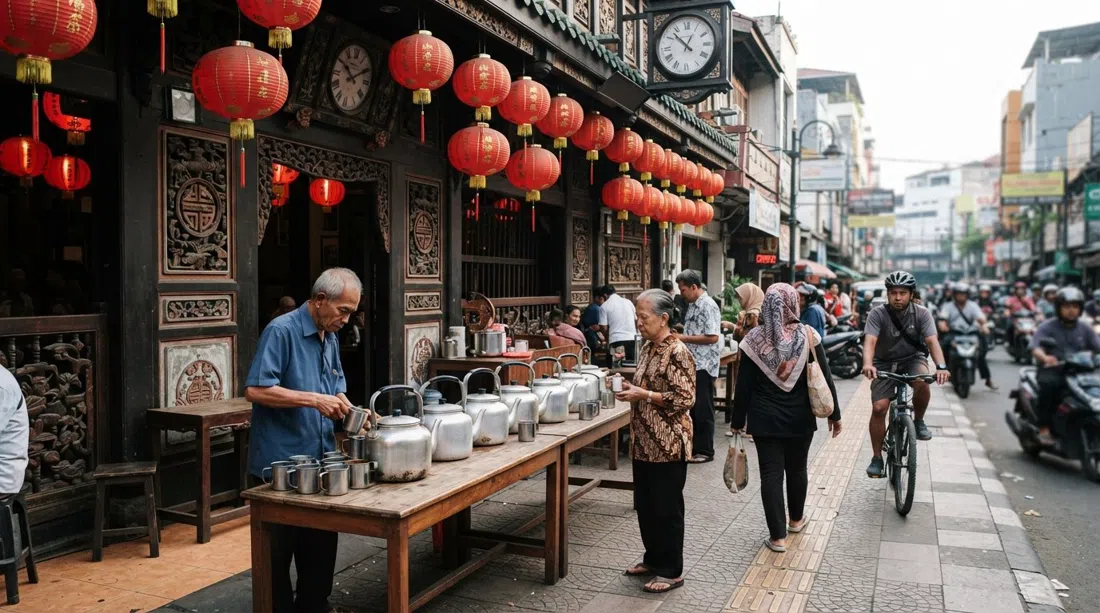
Tea drinkers should make time for Pantjoran Tea House on Jalan Pancoran, a restored 1928 pharmacy building that keeps the Patekoan tradition alive with eight kettles of free tea set out on the pavement for passers-by. It’s a lovely old gesture, not a marketing gimmick, and it belongs to a story about a 17th-century Chinese captain’s kindness that the neighbourhood has decided to keep repeating. Inside, you can order oolong, jasmine and chrysanthemum with dim sum, which is a more civilised way to spend the afternoon than trying to out-hustle the market heat.
Then there is Djauw Coffee, where the neighbourhood’s coffee revival gets a little theatrical in the best way. The coffee is brewed Turkish-style in a pot buried in hot sand, and the signature Kopi Pancoran is black coffee laced with cinnamon and palm sugar. Most drinks run Rp 20,000–50,000. It’s the sort of place that reminds you Glodok is not frozen in amber; it still knows how to make a new habit feel old enough to trust.
Things to do
Glodok rewards slow walking more than a checklist, but there are a few stops that give the wandering a spine. Vihara Dharma Bhakti on Jalan Kemenangan III is the essential one: Jakarta’s oldest Chinese temple, founded in 1650, open roughly 6am–4pm, and busiest on the first and fifteenth day of each lunar month when devotees crowd in to burn joss sticks. Go early if you want the place breathing rather than heaving. The smoke curls under the rafters, the bronze receptacles fill up, and the whole room seems to hum at a lower register than the street outside.
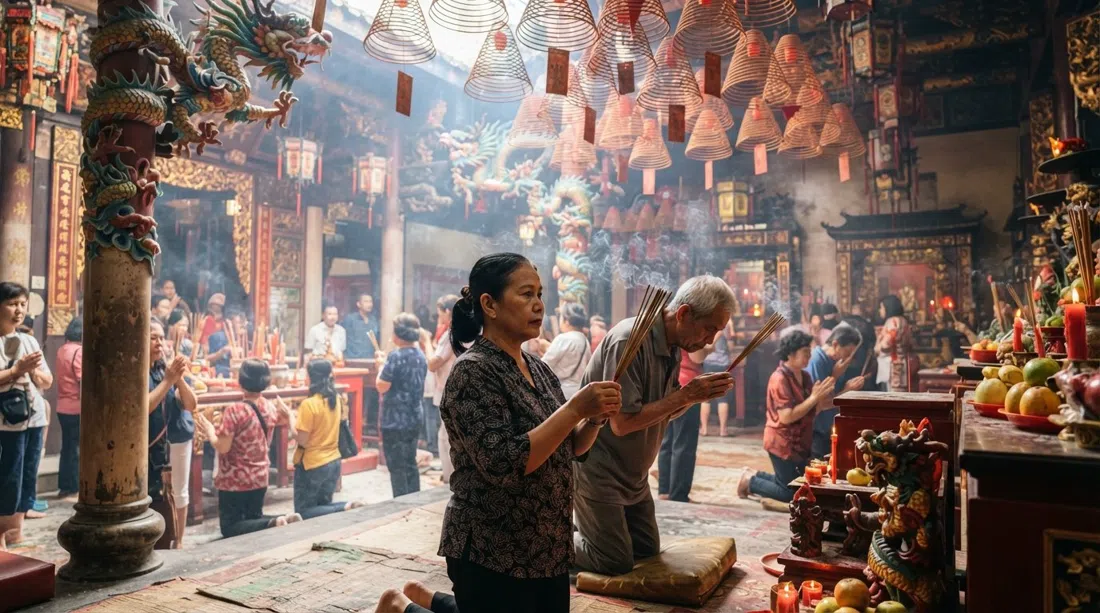
Vihara Toa Se Bio is quieter, older in feeling if not in certainty, with around twenty altars across three rooms. It is the kind of temple you enter more softly than you expect, partly out of respect and partly because the market noise outside makes the calm inside feel earned.
A few doors from the temples, Gereja Santa Maria de Fatima is one of Glodok’s strangest and best sights: a Catholic church built into a 19th-century Chinese captain’s mansion, with a curved Chinese roof, red-and-gold trim and stone lions at the door. Some Masses are still said in Mandarin. That alone tells you enough about Jakarta if you’re willing to listen. The city has always been less tidy than its official stories.
On Jalan Gajah Mada, Candra Naya preserves the courtyard mansion of Khouw Kim An, the last Chinese Major of Batavia. It is now hemmed in by modern development, which is exactly what makes the old house feel even more precious. You duck in, look up at the timber and courtyard, and then step back out into the traffic, which is a very Jakarta kind of time travel.
If you can, plan your visit around Imlek, especially Cap Go Meh fifteen days later. Petak Sembilan turns into a lantern-strung spectacle with barongsai lion dances and market stalls piled with red packets and mandarin trees. It’s the neighbourhood at full volume, but never at full surrender.
Shopping & markets
In Glodok, shopping is not a separate activity; it’s just what the neighbourhood is doing while you’re trying to have lunch. Petak Sembilan is the main event, a traditional wet market where the browsing is as sensory as it is commercial. Tanks of live fish and frogs glint under the fluorescent lights. Roast ducks hang in the windows. Mounds of durian, longan and dragonfruit lean into one another like they’ve lost the right to personal space. Dried-goods sellers stack sacks of mushrooms and medicinal roots the way other places stack fashion accessories.
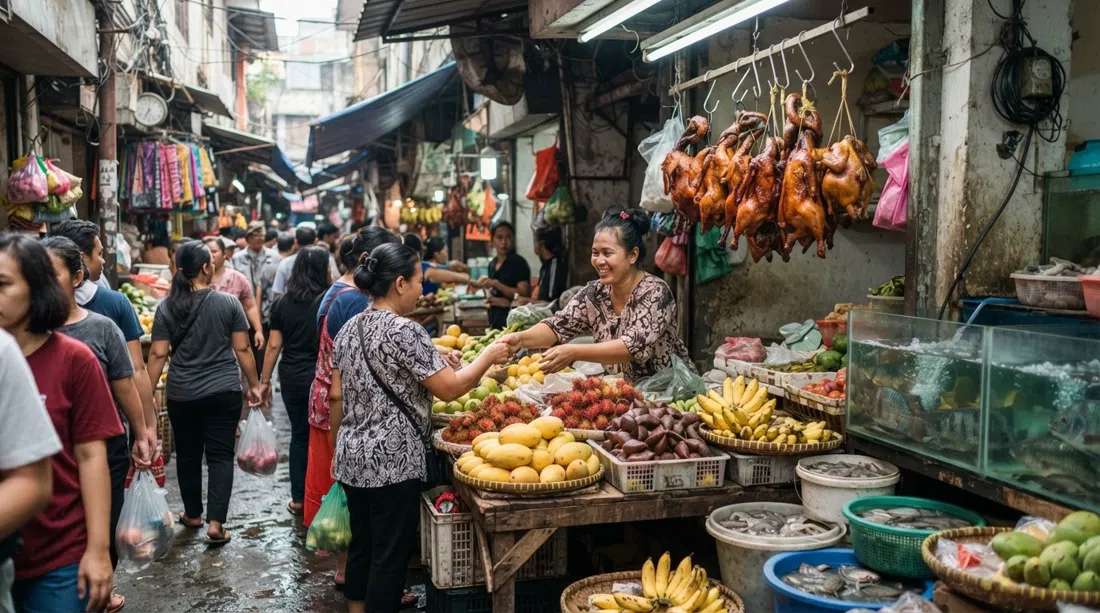
Jalan Pancoran gives the market its spine. Along it you’ll find herbal-medicine shops, incense and candle sellers, and old bakeries selling kue keranjang and bakpao. The street smells like an apothecary that has been interrupted by a bakery, which is probably the correct order for Glodok anyway. Come with small cash notes, haggle gently, and expect to be jostled. This is a place people actually buy their dinner, not a souvenir arcade.
For a cooler, more curated version of the same appetite, Petak Enam di Chandra on Jalan Pancoran No. 43 turns the old Chandra department store into a food hall with around thirty tenants under red lanterns. It’s open daily roughly 09:30–21:00, has no entry fee, and is one of the few places here with reliable restrooms and parking. That makes it useful when the alleys get too much, though “too much” is part of the point in Glodok.
If you want the deeper cut, the older Pasar Pagi Lama morning market a few blocks over trades in everything from hardware to dried seafood and is where several of the legendary eateries, including Wong Fu Kie, took root. It’s less curated, more workmanlike, and all the better for it.
Where to stay in Glodok
Be honest with yourself: Glodok is somewhere to spend a morning and a long lunch, not a night. There are no notable tourist hotels inside the market itself. The nearest sensible bases sit a short ride north on Jalan Gajah Mada, on the edge of Kota Tua, where reliable mid-range and upscale chains put both Chinatown and the colonial square within walking or one-stop reach.
If you want more polish, nightlife or business convenience, most visitors base in central Thamrin or the Menteng and SCBD districts and treat Glodok as a half-day food excursion. That is the right instinct. Come hungry, stay curious, and let someone else handle the duvet.
Getting around
Glodok is compact and best done entirely on foot. The market gangs are too narrow for anything wider than a delivery cart, and becak or ojek motorbikes handle the short hops when your legs start bargaining for mercy. Getting here is easy from central Jakarta. The Glodok TransJakarta stop on Corridor 1 leaves you about a 600-metre, ten-minute walk from the temples and stalls. Alternatively, ride the KRL commuter train to Jakarta Kota station and walk roughly one kilometre south, or grab a short ojek.
Jakarta’s newer MRT line does not currently reach Glodok, so it’s the busway, the commuter train or a Grab/Gojek car through the traffic. Kota Tua’s Fatahillah Square is a 15-minute walk north, which is why the two pair so naturally in a single day. From Glodok, reckon on 30–45 minutes to the Thamrin/Sudirman centre depending on traffic, and 45–60 minutes to Soekarno-Hatta airport off-peak, much more in rush hour.
The best advice is the simplest: arrive early, walk slowly, and leave before the market gets too tired to care about your comfort. Glodok is not trying to charm you with smooth edges. It has better things to do, like feed the city.